Klara Hoffmann · 12 September 2026
Navigating Registrar Transitions for Sustained Indexation Stability in Evolving Web Environments
Domain registrar transitions involve transferring a domain name from one provider to another while preserving the technical settings that search engines rely on for consistent crawling and indexing. Research indicates that these moves require careful coordination of DNS records, nameserver updates, and verification processes to avoid disruptions in how pages appear in search results. Data from industry reports shows that improper handling often leads to temporary drops in visibility because crawlers encounter inconsistencies during the propagation period.
Understanding the Mechanics of Registrar Transfers
Domain transfers follow protocols established by organizations such as ICANN, which sets rules for authorization codes, transfer locks, and confirmation periods that typically last five to seven days. Observers note that registrars must unlock the domain, obtain an EPP code, and initiate the request through the new provider, after which the original registrar has a window to approve or deny the move. Studies from network infrastructure analysts reveal that once the transfer completes, nameserver changes can take up to forty-eight hours to propagate globally, during which search engine bots may receive mixed signals about the site's authoritative records.
Those managing large portfolios often schedule transfers during periods of lower traffic to minimize impact, and they maintain identical DNS configurations at both old and new registrars until full propagation occurs. Figures from domain management platforms indicate that sites with complex setups involving multiple subdomains or integrated email services face additional layers of coordination because each record must remain synchronized throughout the process.
Preserving Indexation Through Technical Consistency
Search engines track sites through a combination of DNS resolution, sitemap submissions, and crawl directives stored in robots.txt files. When a registrar change alters these elements unexpectedly, crawlers may interpret the site as relocated or unavailable, triggering re-evaluation cycles that delay re-indexation. Evidence from web performance databases suggests that maintaining the same IP addresses where possible, or updating them in advance through CDN providers, helps sustain the crawl patterns established before the transition.
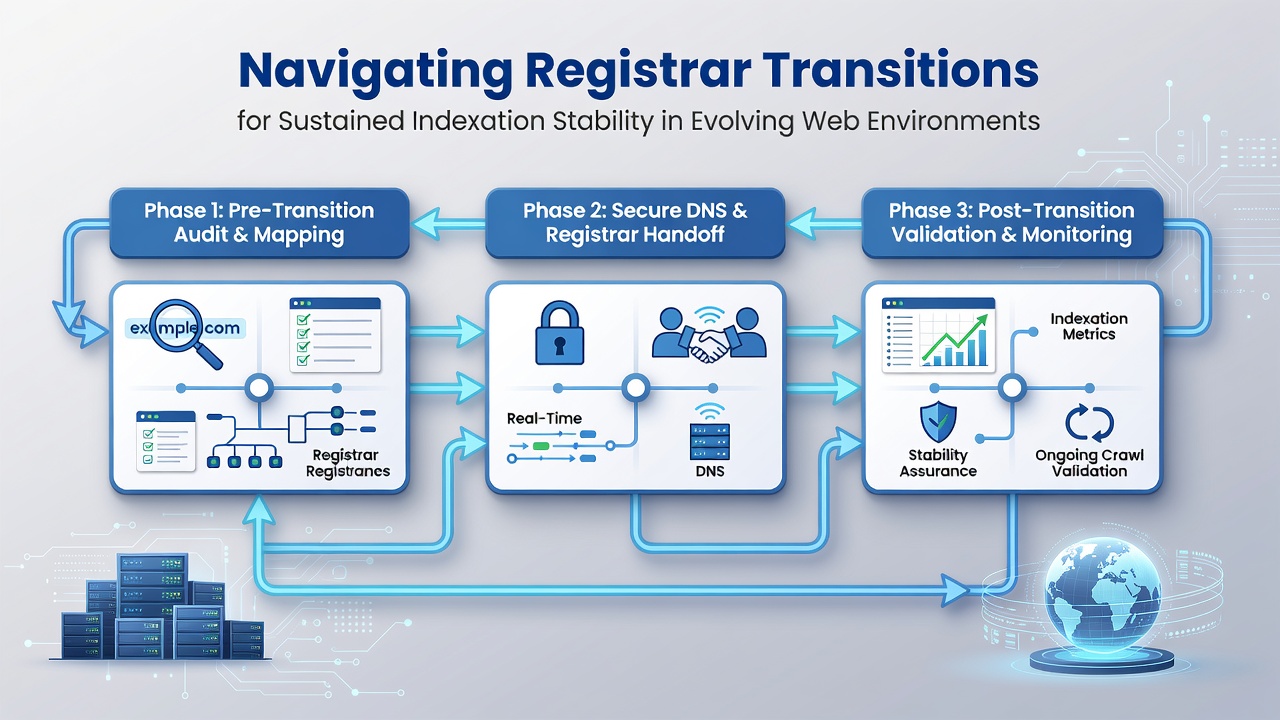
Administrators frequently use verification tools to confirm that all key pages retain their indexed status, checking for errors related to server connectivity or canonical tag mismatches that sometimes arise during nameserver switches. Research published by academic institutions on web architecture demonstrates that sites employing structured data and consistent URL patterns recover indexation faster because algorithms recognize continuity in content signals even when underlying infrastructure shifts.
Monitoring and Verification Protocols
Continuous monitoring begins before the transfer request and extends several weeks afterward, with teams logging crawl statistics, server response codes, and index coverage metrics at regular intervals. Data compiled by analytics firms shows that abrupt changes in crawl frequency often precede visibility fluctuations, prompting immediate checks of DNS propagation status through multiple global resolvers. Experts recommend submitting updated sitemaps immediately after nameserver stabilization and requesting re-crawls for priority URLs to accelerate the process.
Case examples from enterprise web teams illustrate how automated alerts for 5xx errors or sudden drops in indexed pages allow quick intervention, such as temporary rollback of specific records if issues surface. Those overseeing sites in evolving environments also account for mobile-first indexing requirements and core algorithm adjustments that search engines roll out periodically, ensuring that any transition does not coincide with broader platform updates that could compound effects.
Addressing Challenges in Dynamic Web Landscapes
Evolving web environments introduce variables such as increased reliance on edge computing, privacy-focused protocols, and integration with third-party services that depend on stable domain resolution. Reports from technology research groups highlight that domains handling HTTPS certificates through registrars must complete re-issuance or transfer procedures without gaps in validity, since expired certificates can block crawler access entirely. Observers have documented instances where email authentication records like SPF and DKIM required updates alongside the main domain move to prevent deliverability issues that indirectly affect site authority signals.
Preparation includes auditing all connected services, from analytics platforms to content delivery networks, and documenting their dependencies on the domain's authoritative nameservers. As of September 2026, updates to international data handling standards continue to influence how registrars manage privacy settings during transfers, requiring additional compliance checks that teams integrate into their migration timelines.
Conclusion
Successful registrar transitions hinge on sequenced planning that aligns DNS stability with search engine expectations, supported by ongoing verification across the migration window. Organizations that coordinate these elements maintain consistent indexation by treating the process as an infrastructure adjustment rather than a simple account change. Ongoing developments in web protocols and search methodologies underscore the need for adaptable procedures that evolve alongside the broader digital landscape.